Bite down gently and look in a mirror. Do your top teeth sit slightly in front of your bottom teeth, evenly from side to side? If not, you may have a bite problem.
Most people think of crooked teeth as a cosmetic issue. A bite problem goes further. It affects how well you chew, how comfortable your jaw feels and how evenly your teeth wear over the years.
This guide explains overbite vs underbite vs crossbite (plus open bite), what causes them, why they matter and how they are fixed at any age.
What Does a Healthy Bite Look Like?
Dentists call a healthy bite “normal occlusion”. When you close your back teeth together:
- Your upper front teeth sit slightly in front of your lower front teeth, covering a small part of them.
- Your upper back teeth sit slightly outside your lower back teeth all the way around.
- The centre line between your top front teeth roughly lines up with the centre line of your bottom front teeth.
- Your back teeth meet evenly on both sides, with no teeth taking all the pressure.
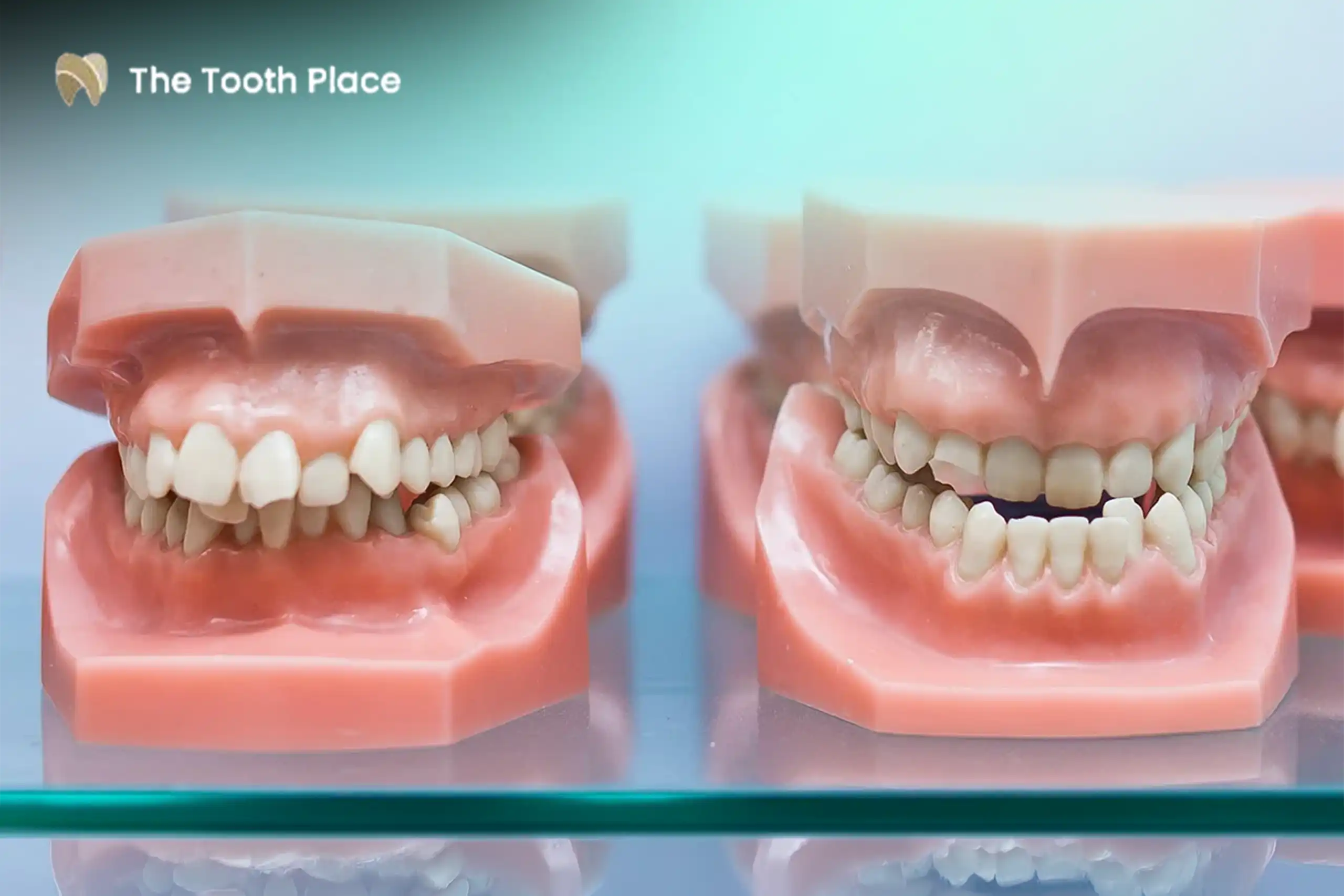
Any noticeable change from this pattern is called a malocclusion. Some are mild and only cosmetic. Others put extra strain on teeth, gums and the jaw joint, which is why an assessment matters more than how straight the teeth look.
Common Bite Problems Explained
Overbite
An overbite is when the upper front teeth overlap the lower front teeth too much, either vertically (a “deep bite”) or by sticking out too far forward (often called “buck teeth”). In a severe deep bite, the lower teeth can bite into the gum behind the upper teeth. It is one of the most common types of malocclusion, and braces for overbite are a well-established fix.
Underbite
An underbite is when the lower front teeth sit in front of the upper front teeth. The chin may look prominent. It can come from tooth position alone or from the lower jaw growing more than the upper jaw, which is why early assessment matters.
Crossbite
A crossbite is when some upper teeth sit inside the lower teeth instead of outside. It can affect front teeth (anterior crossbite) or back teeth on one or both sides (posterior crossbite). A one-sided crossbite can push the jaw off-centre when closing.
Open Bite
An open bite leaves a gap between the upper and lower teeth when the back teeth are closed. A front open bite is often linked to long-term thumb-sucking, soother use or tongue thrusting.
What Causes Bite Problems?
Most bite problems come from a mix of genetics and habits. According to the American Association of Orthodontists, most orthodontic problems are inherited, such as jaw size, tooth size and the way the jaws grow.
Other common contributors include:
- Childhood habits: thumb-sucking, prolonged soother or bottle use, and tongue thrusting
- Mouth breathing: often linked to large tonsils, adenoids or allergies
- Early or late loss of baby teeth: neighbouring teeth drift into the gap
- Missing, extra or impacted teeth
- Jaw injuries that affect how the jaw grows or fits together
Many of these, especially habits and early tooth loss, are easier to manage when spotted in childhood.
Why Fixing Your Bite Matters for Your Health
A bite problem rarely hurts at first, which makes it easy to ignore. Over time it can cause:
Uneven tooth wear. Teeth that hit at the wrong angle wear down, chip or crack faster.
Gum damage. A deep bite can injure the gums behind the front teeth, and crossbites can contribute to gum recession on teeth under extra strain.
Jaw strain. Teeth that do not fit together can make the jaw muscles work harder, leading to soreness or headaches for some people.
Chewing and speech difficulties. Open bites in particular can make biting into food and some speech sounds harder.
Harder cleaning. Crowded, overlapping teeth trap plaque, raising the risk of decay and gum disease.
How Bite Problems Are Treated
The right treatment depends on the type of bite problem, its severity and your age. Here are the main options for bite correction in Bolton.
Traditional Braces
Brackets and wires move teeth gradually and give precise control, making them a strong choice for complex overbites, underbites and crossbites. Best for: moderate to severe cases at any age. Learn more about braces for overbite and other bites. Good hygiene matters during treatment: ask about Icon treatment for white spots after braces, and if you play sports, wear one of the mouthguards for braces.
Invisalign Clear Aligners
A series of removable, near-invisible trays gently shift teeth. With attachments and elastics, Invisalign treatment can correct many mild to moderate overbites, underbites and crossbites. Best for: teens and adults who will wear aligners about 22 hours a day.
Elastics, Expanders and Other Appliances
Rubber elastics help shift the upper and lower jaws relative to each other. A palatal expander gradually widens a narrow upper jaw, a common fix for crossbites in growing children. Habit appliances help children stop thumb-sucking or tongue thrusting.
When Jaw Surgery May Be Needed
When a bite problem comes from the jaw bones themselves and growth has finished, braces alone may not be enough. In these cases, braces are combined with jaw surgery by an oral and maxillofacial surgeon, and we coordinate the referral.
Also Read: Severe Toothache: When Should You See an Emergency Dentist in Bolton?
The Best Age to Check and Correct a Bite
The American Association of Orthodontists recommends a first orthodontic check by age 7. By then, most children have a mix of baby and adult teeth, so problems can be spotted early.
A check at seven does not usually mean treatment at seven. Most children simply need monitoring. A few problems, especially crossbites and some underbites, respond better while the jaw is still growing. Treating them early can make later treatment simpler or shorter.
For most other bite problems, treatment usually starts between about ages 10 and 14, once more adult teeth are in. Your kids dentist can check your child’s bite at regular visits and tell you when a closer look is needed.
Can Adults Still Fix Their Bite?
Yes. Teeth can move at any age as long as the gums and bone supporting them are healthy. More adults than ever are correcting bites they have lived with for years.
Adult treatment often takes a little longer, because adult bone is denser and jaws are no longer growing. Growth-guiding appliances like expanders are less effective after the teens, so adults with jaw-based bite problems are more likely to need surgery alongside braces.
Many adults choose Invisalign for its discreet look, while others prefer braces for complex cases. Both can work well. We will tell you honestly which one suits your bite.
Adults sometimes need other dental work first, such as treating gum disease or replacing old fillings, so teeth move safely.
Also Read: What Does a Cosmetic Dentist in Bolton Do? 7 Treatments to Consider
What Happens at an Orthodontic Consultation
A consultation is a no-pressure visit to understand your bite and your options. It usually includes:
- A conversation about your concerns, health history and any jaw discomfort.
- An exam of your teeth, gums, jaw joints and how your bite closes.
- X-rays and photos to see roots, jawbones and growth.
- A digital scan using iTero digital impressions, which replaces messy impression trays and can show a preview of how your teeth may move.
- A treatment plan with options, estimated timeline and costs.
Cost should not stand between you and a healthy bite. Ask about our monthly dental payment plans.
Get Your Bite Checked in Bolton
Wondering whether you or your child has an overbite, underbite or crossbite? Book a consultation with a dentist Bolton Ontario families trust at The Tooth Place in the Bolton Medical Centre to explore bite correction in Bolton. Call (905) 857-1791 or contact us online, and see real smile transformations.
Frequently Asked Questions
1. What is the most common bite problem?
An overbite is one of the most common bite issues in both children and adults. Crowding often appears alongside it.
2. Can an overbite correct itself?
Usually not. A mild overbite may stay stable, but a significant overbite needs orthodontic treatment to correct, and it can worsen as adult teeth come in.
3. At what age should a child's bite be checked?
Orthodontic associations recommend a first orthodontic check by around age 7. Most children just need monitoring at that stage.
4. Can Invisalign fix an underbite?
It can correct many mild to moderate cases, especially when the cause is tooth position. Severe jaw-related underbites may need braces or jaw surgery.
5. How long does it take to fix a crossbite?
It varies with severity and age, often around one to two years. Children treated with an expander while still growing may need less time.
6. Is a crossbite a problem if it doesn't hurt?
Yes. It can still cause uneven tooth wear, gum recession and jaw strain over time, even without pain.
7. Does insurance cover bite correction?
Many plans with orthodontic coverage do, though some have age limits or lifetime maximums. Our team can check your plan before you start.